From the nectar gathered by bees to the honey in the jar: the stages of production, from foraging to extraction and finally jarring.
Honey comes from the nectar that forager bees collect from flowers and transform through an enzymatic and evaporative process inside the hive. From flower to jar, several stages take place: foraging, transformation in the hive, capping, extraction, settling and jarring.
Foraging: how bees collect nectar
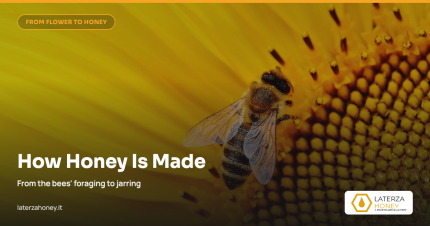
Forager bees leave the hive and visit flowers, collecting nectar with their mouthparts and storing it in an internal sac called the honey stomach, separate from the digestive stomach. During the flight back to the hive, the enzymes produced by the bee already begin to break down the complex sugars in the nectar into simple sugars, a first step in the transformation into honey.
A single forager bee makes dozens of trips a day and visits hundreds of flowers on each trip. The botanical species visited in a given period, depending on what is blooming in the area, determines the type of honey that results: a harvest from mixed blooms gives a wildflower honey, while a harvest concentrated on a single species, if conditions allow, can give a monofloral honey.
Inside the hive: the transformation of nectar
Once back, the forager bee passes the nectar to a house bee through trophallaxis, a mouth-to-mouth exchange that continues the enzymatic breakdown of the sugars. The nectar is then deposited in wax cells, and the bees work to evaporate the excess water, fanning their wings to speed up the process.
Fresh nectar contains a lot of water, usually over 50%; ripe honey contains much less. When the moisture level drops to the right point, the bees seal the cell with a thin layer of wax: this is capping, the signal that the honey is ripe and ready.
Harvesting and seasonality
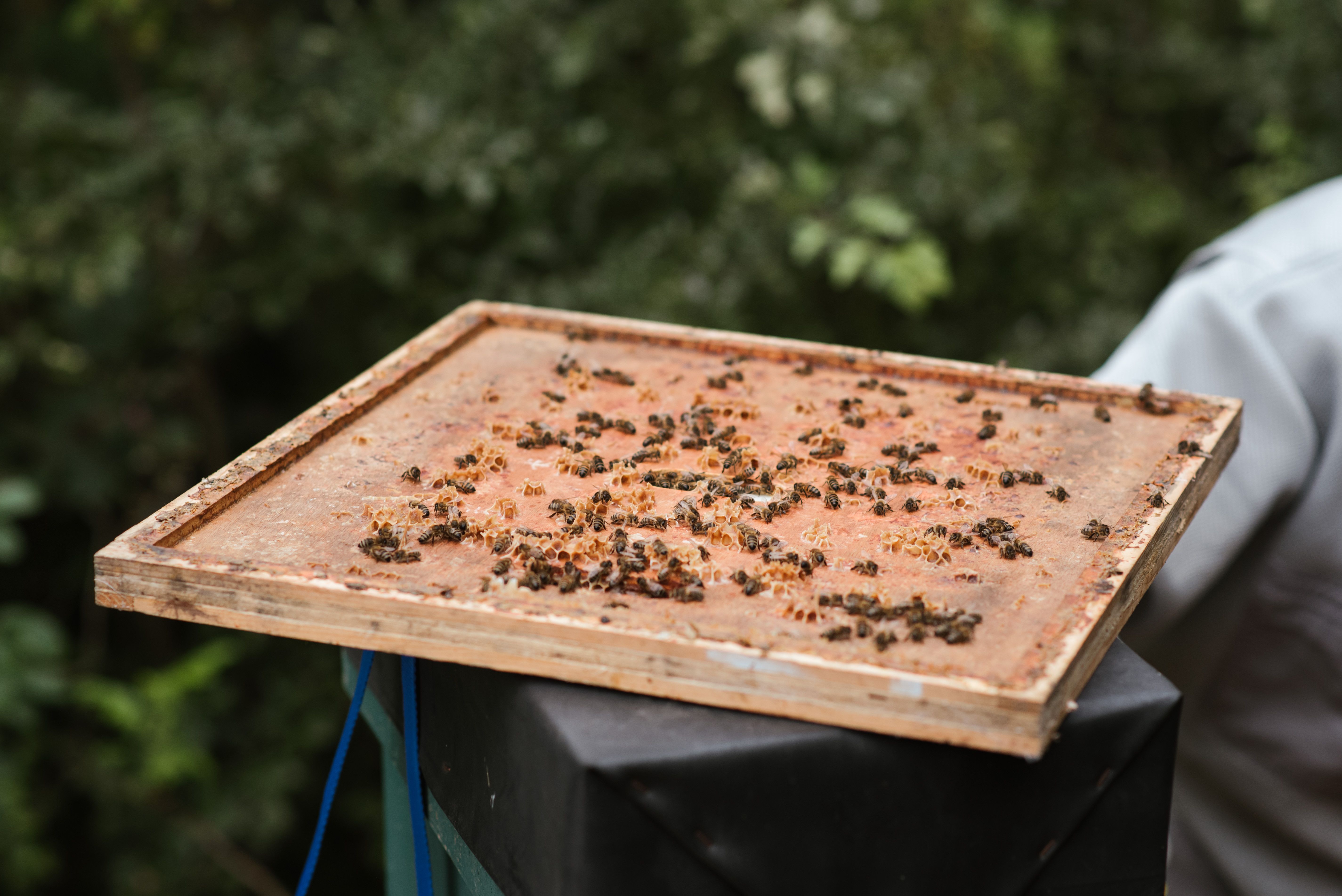
The beekeeper removes the frames only when most of the cells are capped: this is the signal that the honey has reached the correct maturity and will not ferment afterwards. The harvesting period varies by variety: acacia is generally harvested in late spring, chestnut in early summer, and late wildflower honeys even in late autumn, depending on the area and the year's weather conditions.
Each year is different from the previous one: rainfall, temperature and wind during flowering affect the amount of nectar available and, as a result, the colour and aromatic intensity of the harvest. This is one of the reasons why a wildflower honey is never quite the same from one year to the next, even when it comes from the same area.
Extraction
In the laboratory, the frames are uncapped with a knife or a special machine that removes the thin layer of wax sealing the cells. The uncapped frames are then placed in an extractor, a centrifuge that, using centrifugal force, extracts the honey from the cells without destroying the wax comb, which can be returned to the bees for reuse.
Settling, filtering and jarring
Freshly extracted honey still contains small particles of wax and residue, as well as air bubbles incorporated during centrifugation. Settling, which lasts from a few days to a few weeks depending on the temperature, allows these impurities to rise to the surface to be removed (skimming), while the honey settles and clarifies.
The next step is jarring: the honey is poured into jars intended for sale, with a label showing origin, batch and minimum durability date as required by Directive 2001/110/EC on honey and Regulation (EU) 1169/2011 on consumer information.
Why colour and flavour change from one year to the next
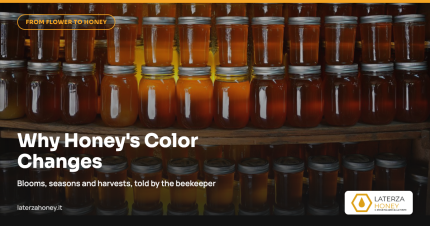
The colour of honey depends mainly on the botanical species of origin and the amount of minerals present in the nectar collected: honeys from woodland blooms or honeydew tend to be darker, while those from herbaceous blooms are lighter. Even within the same variety, different years can produce different shades: this is not an anomaly but the normal variability of a natural product. We explore this in more detail, along with all the factors that influence the colour of a harvest, in our article on why the colour of honey changes from one harvest to another.
From bees to jar: who takes care of the bees
Behind every harvest is the daily work of the beekeeper: checking the health of the colonies, managing swarms, positioning hives according to the area's blooms, and constant monitoring throughout the production season. Anyone curious to get a closer look at the work with bee colonies, from nuclei to hive management, can find out more on the website of Apicoltura Laterza dedicated to nuclei and bee colonies, the company behind the Laterza Honey project.
Discover the Italian honeys of Laterza Honey, from direct production to supply for businesses and individuals.