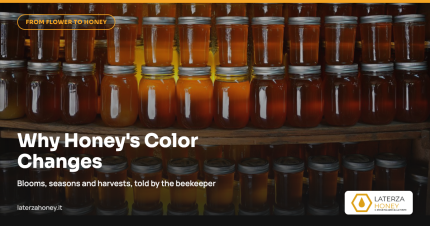
The color of honey depends on its botanical origin, the territory and the season's climate: this is why the same type of honey can change shade from one harvest to another.
The colour of honey changes from one harvest to another because it depends on the botanical species visited by the bees, the territory and the climate trends of the season: each bloom leaves a different "signature" in the nectar. Even the same type of honey, produced in the same area, can have slightly different shades from one year to the next: this is not an anomaly, it is the normal variability of a natural product.
What determines the colour of honey
The colour depends above all on the natural pigments present in the nectar collected by the bees: carotenoids, flavonoids and other plant compounds, together with the mineral salt content. In general, herbaceous blooms and flowers with lighter nectar (acacia, citrus) produce honeys that tend to be lighter; woodland blooms, dark honeys such as chestnut and especially honeydew, which comes from insect secretions on plants rather than flower nectar, contain more mineral salts and turn out darker.
In the honey trade an international scale is also used, the Pfund scale, to objectively measure colour on a range that goes from "water white", almost transparent, to "dark amber". It is a technical measuring tool, not a judgement of quality: a dark honey is not "better" or "worse" than a light one, it is simply different in origin.
Why the same variety changes shade from one year to another
Even when the declared botanical variety is the same, the colour can vary from one harvest to another due to several factors:
Season's climate: a spring that is rainier or warmer than average changes the secretion of nectar and its concentration, affecting the final colour.
Duration of the bloom: a short, intense bloom tends to give a more "pure" and uniform harvest; a long, discontinuous bloom encourages mixing with other species present in the area at that time.
Presence of secondary blooms: if, in the same area, other plants bloom alongside the main species, the bees still collect their nectar, and this is reflected in slight variations in colour and aroma compared to a "clean" year.
Timing of the harvest: extracting honey at the beginning or end of the bloom can give slightly different results, because the composition of the nectar is not constant throughout the bloom.
These same factors also influence the speed at which honey crystallises, another aspect that varies from one year to another: we explain this in our guide on why honey crystallises.
The role of the territory
The same type of bloom, in different geographical areas, can produce honeys with different shades: the type of soil, the microclimate, the altitude, the presence of other crops nearby all change. This is one of the reasons why two chestnut honeys or two wildflower honeys, produced in different regions, are never identical even though they share the same botanical name.
Colour and flavour: is there always a relationship?
There is a general tendency, not a fixed rule: darker honeys tend to have a more intense aroma and flavour, lighter ones a more delicate profile. This is a tendency that can be observed by comparing, for example, acacia, very light and delicate, with chestnut, dark and bold. Within the same variety, however, differences in colour from one year to another do not necessarily involve proportional differences in flavour: a slightly darker harvest of the same wildflower honey can have an aromatic profile very similar to that of the previous year.
The colour also changes over time, after jarring
Besides the differences between one harvest and another, the colour of the same jar can change slightly over time: honey tends to darken very slowly over the months, especially if stored in warm environments, due to natural chemical reactions linked to sugars. Crystallisation, moreover, visually lightens the honey, which shifts from a transparent shade to a lighter, opaque one: this too is not a defect, but a normal change, described in our guide to storing honey.
Why this matters to Laterza Honey
Working every year with different harvests, direct experience in the apiary teaches you not to view a change in colour as a problem: it is part of the nature of the product. What must remain constant is not the exact shade, but the consistency between the botanical name on the label and the actual organoleptic characteristics of the honey, as well as the care taken during the extraction and settling stages described in our in-depth article on how honey is made.
Conclusion
The colour of honey tells the story of the botanical origin, the territory and the course of the season in which it was produced: it changes from one harvest to another for natural reasons, not because of a processing defect. Knowing these factors helps you read the product with more awareness, instead of expecting every jar to be identical to the last.
Discover Laterza Honey's Italian honeys and their characteristics, harvest after harvest.