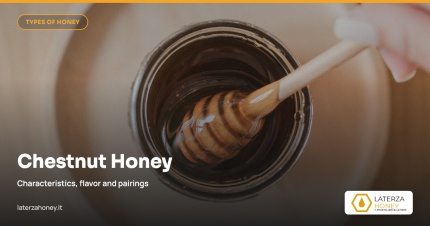
Dark color, assertive and slightly bitter flavor, slow crystallization: everything you need to know about chestnut honey, from culinary pairings to how to recognize an authentic one.
Chestnut honey is a dark monofloral honey with a pronounced, slightly bitter taste, produced by bees mainly between June and July in hilly and mountainous areas where chestnut trees bloom. It is recognized by its dark amber color tending towards brown, a persistent aftertaste, and a low tendency to crystallize.
Botanical origin and production period
Chestnut honey is born from the nectar of Castanea sativa flowers, the chestnut tree widespread on the Apennines and Alps, generally between 300 and 1000 meters altitude. Flowering is concentrated in a short period, roughly from mid-June to mid-July, making it one of the first summer monoflorals available after acacia.
Production depends on the year's climate: rain or wind during flowering can significantly reduce the harvest, which is why the amount of chestnut honey available varies more than that of other varieties.
Color, aroma and taste
The color ranges from dark amber to reddish-brown, often with greenish reflections when the honey is still liquid. On the nose it is intense, with notes reminiscent of wood, bark and, in some cases, a slightly pungent hint.
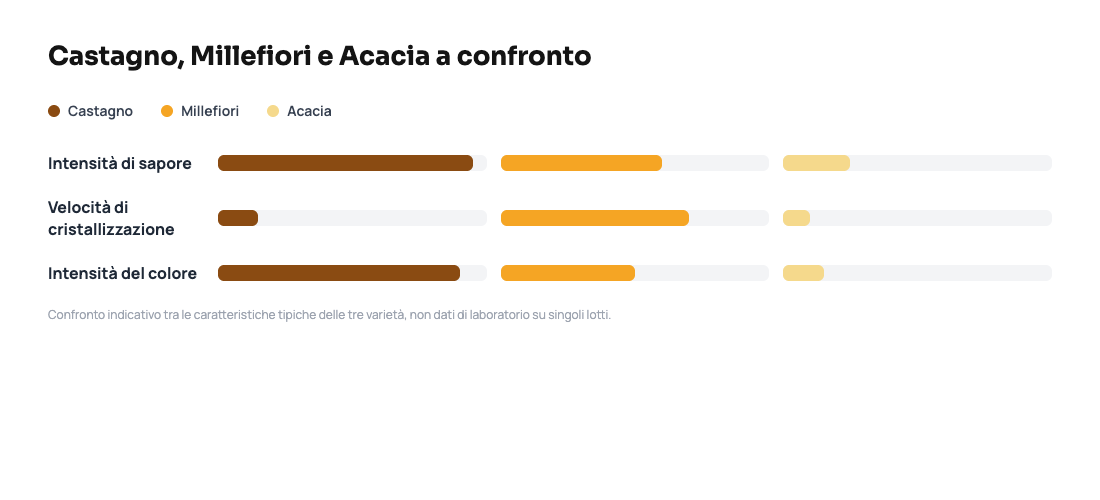
Taste is the characteristic that distinguishes it most clearly from other Italian monoflorals: pronounced, not very sweet relative to the perceived intensity, with a bitter and tannic aftertaste that lingers in the mouth. It is not a "delicate" honey: those tasting it for the first time notice it immediately, and it is precisely this intensity that makes it valued for robust pairings.
Why chestnut honey crystallizes rarely
Chestnut honey remains liquid longer than most Italian monoflorals, often for a year or more from jarring. The reason is its relatively high fructose content compared to glucose: glucose is the sugar that, when crystallizing, forms the typical granules of solid honey, while fructose tends to remain in solution longer.
Over time, and especially if stored at low temperatures, chestnut honey too can begin to crystallize forming a coarse and irregular structure, different from the fine and compact crystallization typical of a multifloral. It is not a defect: it is the same chemical dynamic that governs the crystallization of every honey, also described in our guide on how to store honey.
Chestnut honey: kitchen pairings
The intensity of chestnut stands up to equally pronounced flavors. The most natural pairings are those with aged cheeses and dishes where a sharp contrast is needed, not a discreet accompaniment.
Blue-veined and aged cheeses: gorgonzola, aged pecorino, mature goat cheeses.
Meats and cured meats: braised meats, game, fatty cured meats like lard or pancetta.
Baked goods: castagnaccio, rustic cakes, biscuits with dried fruit.
Beverages: bitter herb infusions, full-bodied black teas.
It is not the right choice for those looking for a honey to dissolve in a delicate herbal tea or to use in a dessert with neutral taste: in those cases an acacia or light multifloral remain more balanced.
| Characteristic | Chestnut honey | Acacia honey |
|---|---|---|
| Color | Dark amber, reddish-brown | Pale yellow, almost transparent |
| Taste | Pronounced, bitter, tannic | Delicate, very sweet |
| Crystallization | Slow, often over 12 months | Very slow, among the slowest overall |
| Typical pairing | Aged cheeses, meats, rustic desserts | Herbal teas, yogurt, delicate desserts |
How to recognize quality chestnut honey
Some signs help distinguish authentic chestnut honey from a blended product or imprecisely labeled:
The bitter aftertaste must be present and persistent, not just barely perceptible.
The dark color must be uniform, without clear separation between light and dark layers in the jar.
The label must state the botanical origin "chestnut" only when the product predominantly derives from this flowering, with organoleptic characteristics consistent with current honey regulations.
A chestnut "too sweet" or lacking aftertaste is probably blended with other more neutral honeys.
The designation of botanical origin on the label is regulated in Italy by Legislative Decree 21 May 2004, n. 179, which implements Directive 2001/110/CE on honey.
Storage
Chestnut honey is stored like any other honey: protected from direct light, at stable room temperature, in a well-sealed container. Complete instructions, including rules on minimum shelf life, are in our guide on how to store honey.
Discover Laterza Honey's Italian honeys, from direct production to supply for businesses and individuals.