Nearly transparent color, orange blossom aroma and medium crystallization: everything you need to know about citrus honey, from culinary pairings to how to recognize an authentic one.
Citrus honey is a clear and delicate monofloral honey, produced from the nectar of orange, lemon and mandarin blossoms during the spring flowering season. It is recognized by its almost transparent liquid color, fresh and floral aroma with citrus notes, and medium-fast crystallization that turns it white and creamy after a few months.
Botanical origin and production period
Citrus honey originates from the nectar of flowers of plants in the genus Citrus, mainly orange, but also lemon, mandarin and bergamot depending on the area. Flowering is concentrated in a short period, between March and May, and concerns mainly areas with mild climate in Central-Southern Italy and the islands, where citrus groves are most widespread.
Being an early and localized flowering, the yield depends greatly on weather conditions during those few weeks: rain or wind during the flowering period reduces the amount of nectar available to bees, with direct effects on that year's production.
Color, aroma and flavor
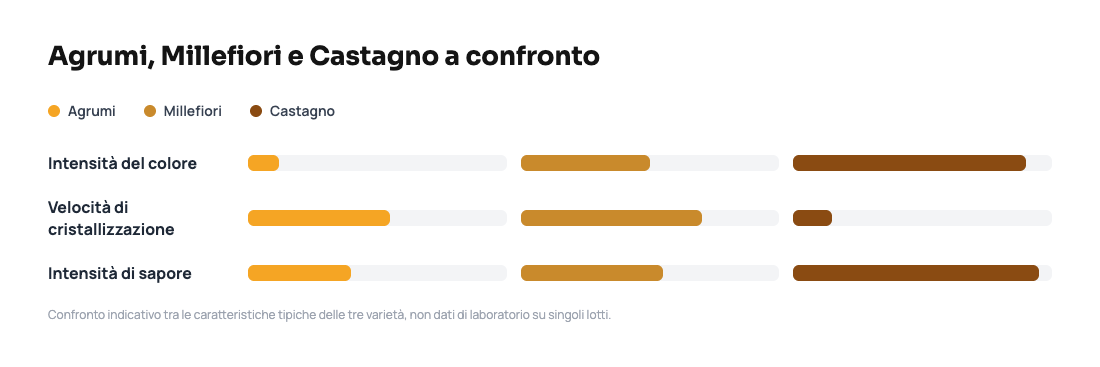
In liquid form, citrus honey has a color ranging from almost colorless to pale straw yellow; once crystallized it becomes white or very light beige, with a fine and creamy texture. It is among the clearest Italian honeys alongside acacia.
Its aroma is its distinctive feature: intense and recognizable, with fresh floral notes and a citrus component that recalls zagara, the orange blossom. The flavor is sweet with a slight acidulous note at the finish, less flat than other clear honeys, but without the intensity and bitterness typical of more decisive varieties such as chestnut.
Crystallization of citrus honey
Citrus honey crystallizes at an intermediate speed: normally within a few months from extraction, with granulation that can be coarse if the honey is stored in warm environments during the crystallization phase. This is not a defect, but a characteristic of its sugar composition, the same dynamic described in our guide on why honey crystallizes.
Once crystallized in a fine and uniform manner, citrus honey takes on an almost creamy consistency, appreciated by those who prefer it spreadable rather than liquid.
Citrus honey: culinary pairings
Its delicacy and floral note make it versatile, suitable for everyday use rather than bold pairings.
Breakfast: plain yogurt, ricotta, crackers, pancakes.
Delicate desserts: fruit tarts, pound cakes, citrus-based sweets where it reinforces the aromatic profile without masking it.
Beverages: herbal teas and light teas, in which the orange blossom note remains perceptible.
Fresh cheeses: robiola, fresh goat cheese, light salted ricotta.
It is not the best choice to accompany aged cheeses or dishes with intense flavor, where its delicacy risks going unnoticed: in those cases a chestnut or sulla honey holds up better to comparison.
| Characteristic | Citrus honey | Wildflower honey |
|---|---|---|
| Color | Almost colorless, white once crystallized | Light amber, variable from harvest to harvest |
| Aroma | Floral, orange blossom notes | Variable, less defined |
| Crystallization | Medium, within a few months, fine granulation | Fast, often within a few weeks |
| Typical pairing | Breakfast, delicate desserts, herbal teas | Generic everyday use |
How to recognize quality citrus honey
Some elements help assess the authenticity and quality of citrus honey:
The orange blossom aroma must be clear and recognizable, not a generic floral hint.
The color, in liquid form, should remain very light: dark citrus honey is probably blended with other flowers.
The botanical name "citrus" on the label is only permitted when the product derives predominantly from this flowering, as provided by honey regulations.
A flavor that is too neutral or lacking the citrus note at the finish may indicate wildflower honey labeled inaccurately.
The botanical origin designation on the label is regulated in Italy by Legislative Decree 21 May 2004, no. 179, which implements Directive 2001/110/EC on honey.
Storage
Like all honey, it should be kept away from direct light and heat sources, in a well-sealed container at stable room temperature. Complete instructions are in our guide on how to store honey.
Discover Laterza Honey's Italian honeys, from direct production to supply for businesses and individuals.