In this guide (8)
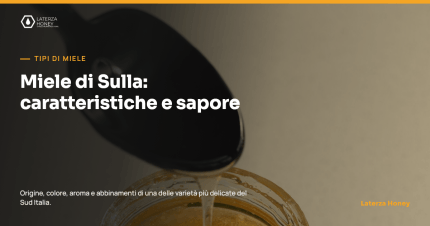
Sulla honey is one of the lightest and most delicate monofloral honeys from Central-Southern Italy. It comes from the nectar of sulla (Hedysarum coronarium), a forage plant that grows well on clay soils where other crops struggle. In its liquid state it is almost transparent; over time it crystallises quickly, taking on an ivory-white colour.
Where sulla honey comes from
Sulla is a herbaceous legume widespread mainly in Central and Southern Italy, including the hilly areas of Puglia. It blooms between April and June, peaking in April-May, producing inflorescences with a characteristic purplish-red colour (more rarely white). It is also a highly valued plant in agriculture, as it improves difficult soils where other legumes struggle to take root.
The honey bees produce from this bloom is classified as monofloral when sulla nectar is predominant, according to the criteria of Directive 2001/110/EC on honey.
Colour and appearance
Freshly extracted, Sulla honey has a very light straw-yellow colour, among the palest of Italian monofloral honeys. However, it crystallises relatively quickly, generally within 1-3 months of extraction, taking on a compact, creamy consistency and a colour that shifts towards ivory white. This is not a defect: it is the typical behaviour of this variety, as we explain in our guide on why honey crystallises.
Aroma and flavour
The sensory profile of Sulla honey is delicate: a fruity and vegetal aroma, with notes reminiscent of freshly cut hay and, in some samples, green tea. The flavour is sweet and not very intense, with a slight sour note that makes it less cloying than other light honeys. It is precisely because of this delicacy that it is often described as a "transitional" honey, suitable for those who prefer a less decisive taste compared to chestnut or eucalyptus honey.
Crystallisation: what to expect
Sulla honey crystallises in a relatively short time, generally within 1-3 months of extraction: in our guide on why honey crystallises we place it among the intermediate times, alongside eucalyptus and citrus honey, faster than acacia and chestnut but less immediate than varieties such as dandelion. The result is a fine, creamy mass that is easy to spread, different from the grainier texture of other crystallised honeys. If you prefer Sulla honey in liquid form, for example to sweeten drinks, you can return it to a fluid state by warming it in a water bath without exceeding 40°C: details in the dedicated guide.
Pairings in the kitchen
The delicate flavour of Sulla honey lends itself to equally delicate pairings:
fresh or soft cheeses, which don't mask its vegetal note;
tea and herbal infusions, where it dissolves easily without altering the flavour;
nuts, particularly almonds;
breakfast, on plain yoghurt or rusks, thanks to its creamy texture once crystallised.
For more structured pairings, for example with aged cheeses, our guide on which honey to pair with cheese explores the topic variety by variety.
Wholesale Sulla honey: a product for businesses too
Precisely because of its delicate profile, Sulla honey is a frequent choice for pastry shops, ice cream parlours and food labs looking for an unobtrusive sweetener that doesn't overpower other ingredients. Its creamy texture once crystallised also makes it practical as a filling or topping. Those buying wholesale honey for their business can ask us for information on formats and supply times.
Honey, of any variety, should not be given to children under 12 months of age, due to the risk of infant botulism linked to the possible presence of Clostridium botulinum spores: this is a food safety requirement, not an option.
How to recognise good Sulla honey
The same general guidelines apply as for any honey: a complete label with the information required by Regulation (EU) 1169/2011, natural crystallisation over time, and the absence of foreign flavours. For Sulla honey in particular, the very light colour when liquid and the shift towards ivory white after crystallisation are two signs consistent with the stated botanical origin. Our guide on how to recognise quality honey lists a complete checklist applicable to all varieties.
Conclusion
Sulla honey is one of the most delicate varieties in our range: very light colour, vegetal aroma, rapid crystallisation into a fine, creamy mass. A suitable choice for those looking for a sweetener with a subtle taste, both for everyday consumption and for professional use in the kitchen.
Discover Laterza Honey's Sulla honey or the entire range of Italian honeys.