

The more aged and savory the cheese, the darker and more robust the honey should be. A practical guide to pairings, from fresh cheeses to blue cheeses.
The general rule is: the more aged and savory the cheese, the darker and more decisive the honey should be; the fresher and more delicate the cheese, the clearer and lighter the honey should be. It's not a random pairing, but a balance between flavor intensity.
The principle of cheese-honey pairing
Honey in a pairing with cheese works on two levels: it adds sweetness where the cheese is savory or spicy, and creates contrast where the cheese is fatty, balancing it with the honey's natural acidity. A fresh and creamy cheese is overwhelmed by too intense honey; an aged and savory cheese, on the other hand, easily "wins" over too delicate honey, which ends up not being noticed.
Which honey to choose based on cheese
Fresh and creamy cheeses (robiola, stracchino, caprino fresco, ricotta)
Better to choose clear and delicate honey, such as acacia or light multifloral: it adds sweetness without covering the freshness of the cheese.
Semi-hard cheeses (young pecorino, caciotta, asiago)
A medium intensity multifloral or citrus honey works well: enough character to hold its own, without being intrusive.
Aged and savory cheeses (aged Parmigiano, aged pecorino)
Here more decisive honeys are needed, such as chestnut: its bitter aftertaste balances the savory notes and fatty component of the cheese. Find the complete characteristics in our guide to chestnut honey.
Blue cheeses (gorgonzola, blue cheeses)
The classic pairing is with dark and intense honey, chestnut or honeydew: the contrast between the cheese's sharp savory notes and the honey's bitter component is one of the most balanced pairings of all.
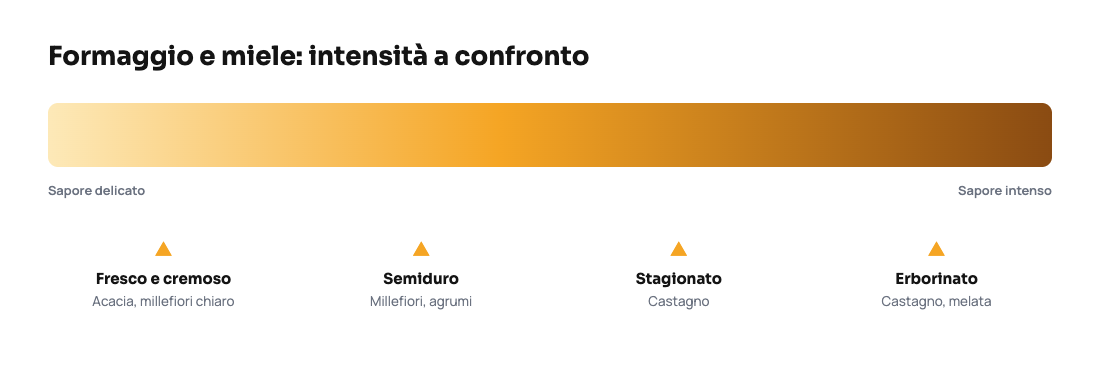
| Type of cheese | Recommended honey | Why |
|---|---|---|
| Fresh and creamy | Acacia, light multifloral | Does not mask the delicacy of the cheese |
| Semi-hard, young | Multifloral, citrus | Balance between sweetness and character |
| Aged and savory | Chestnut | The bitter aftertaste balances the savory notes |
| Blue cheese | Chestnut, honeydew | Sharp contrast between bitter and savory |
Substituting sugar with honey in cooking
Honey can replace sugar in many preparations, but not in a 1:1 ratio. Some general practical guidelines:
Honey is more sweetening than sugar at equal weight: generally about 3/4 cup of honey is used for every cup of sugar to be replaced.
Honey adds extra liquid to the mixture: the quantity of other liquids in the recipe should be slightly reduced.
Honey darkens and caramelizes more quickly than sugar: in baked goods, it's useful to lower the oven temperature by about 10-15°C compared to the original recipe.
In a herbal tea or hot beverage, it's preferable to add honey when the liquid is no longer boiling: too high temperatures alter the honey's aroma and organoleptic characteristics.
Other practical uses in cooking
Breakfast
Honey goes well with plain yogurt, ricotta, oatflakes or a slice of toasted bread. A balanced multifloral is the most versatile choice for everyday breakfast.
Marinades and glazes
In marinades for meat or vegetables, honey balances vinegar or soy sauce and promotes caramelization during cooking or grilling. In this case, a honey with a more neutral flavor, such as multifloral, leaves more room for the other ingredients in the marinade.
Baked goods
Honeycake, spiced cookies, rustic cakes: here chestnut honey or dark multifloral give character to the dough, while acacia is indicated when you want a dessert with a more delicate taste.
Honey and small children: a necessary warning
Honey should not be given to children under 12 months of age: it may contain spores of Clostridium botulinum which, in the still immature intestines of an infant, can cause infant botulism. It's a food safety rule, not an optional recommendation, and applies to any type of honey, including cooked honey or honey added to other foods.
Discover Laterza Honey's Italian honeys to find the variety best suited for every recipe.