Traceable origin, supply continuity and proper documentation: how to evaluate a bulk honey supplier for shops, pastry shops and Ho.Re.Ca.
A good wholesale honey supplier is evaluated on three points: declared and verifiable origin, continuity of supply throughout the year, proper documentation for resale. The lowest price is never the first criterion: cheap honey that doesn't hold up through the season or lacks proper labeling creates more problems than the savings gained.
Why supplier choice matters more than price per kilo
Anyone who buys honey to resell it, whether in a shop, as an ingredient in a lab or in a Ho.Re.Ca. establishment, takes on a responsibility to the end customer: they must be able to guarantee what they are selling. A supplier that doesn't provide clear traceability, that changes the product's origin without communicating it, or that doesn't respect agreed quantities creates a problem that falls on the downstream business, not on the one who sold at a low price.
This is why evaluating a wholesale honey supplier should start with objective criteria, not just the price list.
What to verify before choosing a supplier
Origin and traceability
The supplier must be able to indicate with precision the origin of the honey: own production, Italian beekeepers as suppliers, or blends with foreign origin declared on the label. Supply chain traceability, as required by Regulation (EC) 178/2002, is a requirement, not an optional added value: anyone reselling must be able to trace back to the batch and origin in case of inspection or dispute.
Continuity and quantities
Honey production varies from year to year based on climate and flowering. A serious supplier communicates in advance if a variety is scarce, proposes coherent alternatives, and avoids leaving a professional customer without product mid-season. For those who buy continuously, it's worth asking whether the supplier also works with scheduled supply contracts, useful for planning orders for a year.
Documentation and labeling
Every shipment intended for resale must comply with the labeling rules provided by Regulation (EU) 1169/2011 on consumer information and by Directive 2001/110/EC on honey: origin, batch, minimum shelf life, any blend of honeys of EU and non-EU origin. Anyone working in the food sector must also be able to rely on a supplier that complies with the hygiene rules set out in Regulation (EC) 852/2004 throughout the supply chain.
Available formats
Among the varieties most requested by professional customers is chestnut honey, appreciated for its strong flavor in gastronomic pairings.
The requested format varies greatly depending on use: a restaurant or B&B works well with single-portion jars or 250-500 g pots for the dining room, a pastry laboratory needs buckets of several kilos for production, a shop selling retail requires jars ready for the shelf, possibly with custom label (private label). A supplier that covers multiple formats avoids having to manage multiple contacts for the same product.
Direct purchase from the producer or through an intermediary
It's not always an obvious choice. Each option has real advantages and limitations.
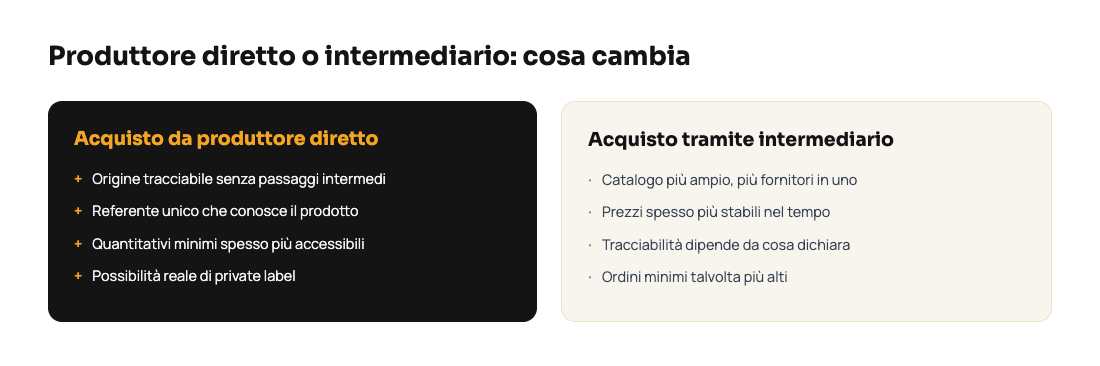
| Aspect | Direct producer | Intermediary/wholesaler |
|---|---|---|
| Origin traceability | Direct and verifiable | Depends on what the intermediary declares |
| Price continuity | Tied to the producer's harvest years | Often more stable, with margin included |
| Customization (private label, formats) | More flexible if the producer has a dedicated line | Variable based on catalog |
| Minimum quantities | Often more accessible for small businesses | Sometimes requires larger orders |
For those seeking a direct relationship with the producer, with the opportunity to speak with someone who truly knows the product, purchasing from an Italian producer remains the most transparent channel.
Minimum quantities and logistics
Before starting a supply relationship, it's useful to clarify some practical points: minimum order quantity, delivery times, possibility of recurring automated orders, return conditions in case of product damaged in shipping. These are details that affect daily management more than the unit price.
Questions to ask before signing a supply agreement
Where does the honey come from and how is the origin documented?
Which varieties are available year-round and which only in season?
Is it possible to request custom labeling (private label)?
What is the minimum quantity per format?
How are returns or supply discrepancies handled?
Apicoltura Laterza supplies Italian honey wholesale to businesses, shops and Ho.Re.Ca. establishments, with professional formats and private label options. For a supply request write to info@laterzahoney.it or visit laterzahoney.it.