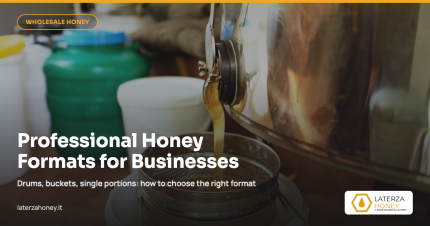
Single-dose, jar, bucket or 300 kg barrel: how to choose the professional honey format best suited to your channel, among restaurants, pastry shops, retail stores and industry.
Wholesale honey is purchased in many different formats: from ready-made jars for the shelf, to 5-25 kg buckets for laboratory processing, up to 300 kg drums for high volumes. The right format depends on how the honey will be used, not just on the quantity: a restaurant and an industrial bakery have very different needs even with the same annual consumption.
Why format matters more than price per kilo alone
Those buying honey for their business often look only at the price per kilo, but format affects other costs that show up later: transfer time, waste from residue in large containers, storage space, how quickly the product is consumed before it crystallizes in an inconvenient way to manage. A format designed for real use reduces these hidden costs more than a discount on unit price.
Available professional formats
| Format | Approximate | Suitable for |
|---|---|---|
| Single dose | 15-25 g | Hotel and B&B breakfasts, bars, catering, buffets |
| Retail jar | 250-1000 g | Shops, delicatessens, retail sales, local retail chains |
| Bucket | 5-25 kg | Pastry shops, bakeries, ice cream parlors, artisan laboratories |
| Drum | 300 kg | Food industry, large-scale processing, high volumes |
Single dose
Designed for individual consumption, it reduces waste and spillage from shared spoons, but has a higher cost per kilo compared to bulk formats. It is the most common choice for hospitality: hotels, B&Bs, served breakfasts, catering.
Retail jar
The format designed to reach the end consumer as-is, without further transfers. It serves shops, delicatessens and retail points that display the product on the shelf with the label already ready for sale.
Bucket (5-25 kg)
The most common compromise for those who use honey as an ingredient: pastry shops, bakeries, ice cream parlors. The food-grade plastic or tin container opens and closes multiple times without the typical waste of a drum, and is easy to move around in the laboratory without dedicated equipment.
Drum (300 kg)
The format with the lowest cost per kilo, suitable for those who consume large quantities quickly: confectionery industry, large-scale food processing. It requires equipment for transfer and adequate storage space; if consumption is slow, the risk is that the final part of the drum crystallizes in a way that is difficult to recover.
How to choose based on your channel
Restaurants and Ho.Re.Ca.: single dose for the dining room, small bucket for the kitchen if honey is also used as an ingredient.
Pastry shops and bakeries: bucket of 10-25 kg, with frequent reorders to always work with fresh honey.
Shops and delicatessens: retail jar, in the sizes most requested by your customers (250-500 g for regular sales, 1000 g for regular customers).
Hotels and B&Bs: single dose for buffet breakfasts, where service hygiene matters more than unit cost.
Industry and large-scale processing: 300 kg drum, if volumes and consumption speed justify it.
If you don't yet have a defined channel, or are buying wholesale for the first time, find more general guidance in our guide on how to choose a wholesale honey supplier.
Custom label and private label
For shops and brands that want to sell honey under their own brand, custom labeling (private label) is an option to evaluate together with your supplier. The aspects to clarify before proceeding are always the same: minimum quantities required, label production times, label compliance with Regulation (EU) 1169/2011 on consumer information, and who assumes responsibility for mandatory statements (origin, batch, minimum shelf life). To check the availability of this service and the conditions, contact Laterza Honey.
Traceability and storage for large quantities
Regardless of format, every professional supply must guarantee batch traceability, as required by Regulation (EC) 178/2002, which requires food business operators to be able to trace back to suppliers and recipients of each batch placed on the market. For those buying in large formats, it is also advisable to:
Schedule reorders based on actual consumption, avoiding drums left open for months.
Store buckets and drums away from heat sources, like any other honey.
Apply FIFO rotation (first in, first out) among batches in storage.
The basic principles are the same as for the private consumer, explained in our guide on how to store honey, applied however to larger volumes and warehouse rotation.
Conclusion
There is no "best" format in absolute terms: the choice depends on the channel, how quickly the honey is consumed, and the type of use, whether as an ingredient or as a finished shelf product. Evaluating these elements before ordering prevents waste and management issues better than simply comparing prices per kilogram.
Discover the available formats among Laterza Honey Italian honeys and request more information for your business.